If you run a recording studio, sooner or later a booking lands in your inbox that looks almost too good: an overseas company, a full-day commercial session, no haggling over price. Before you reply with a quote, read this. It’s very likely the recording studio scam email that’s been making the rounds — and it’s designed to drain money from your business, not bring it in.
Here’s a real example we received at Violet Recording:
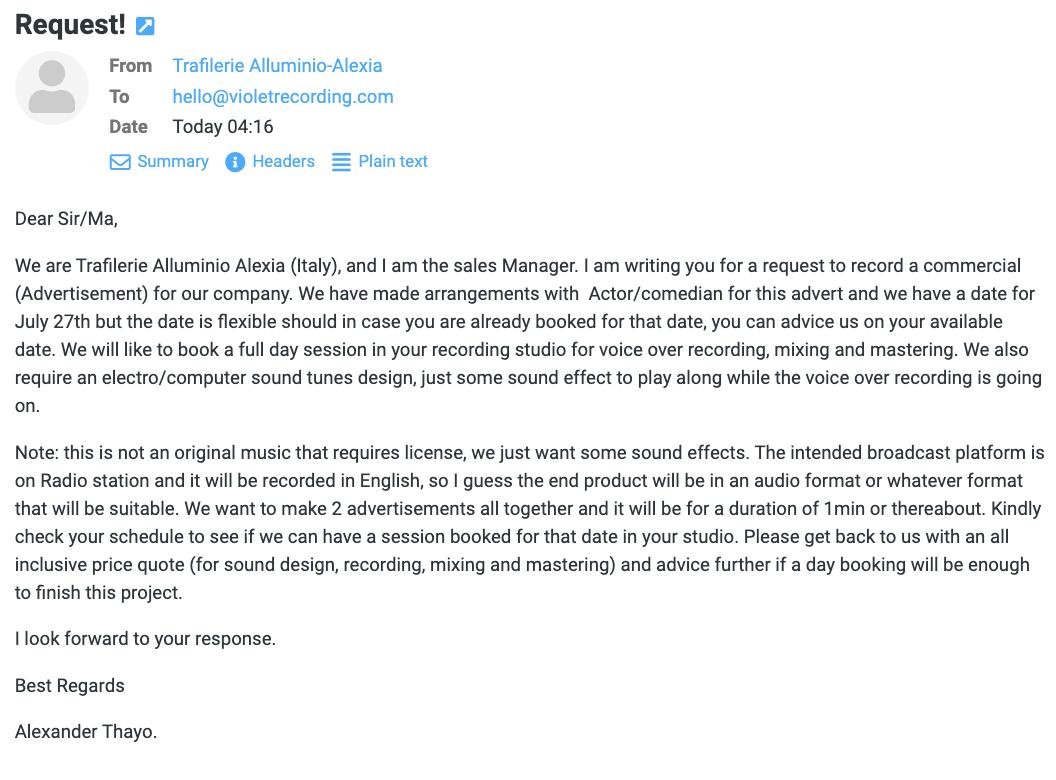
Important: the company named in this email — Trafilerie Alluminio Alexia — is a real, legitimate aluminium manufacturer in Italy and is not behind this scam. Their name and identity have been hijacked by fraudsters, most likely off the back of a 2024 data breach. They are a victim here too. We’re naming them only because the email does, and to show how convincingly scammers borrow real businesses.
Try the free Online Equalizer →
How the recording studio scam works
The email is the bait, not the trap. The scam unfolds in stages:
- The friendly inquiry. A polite, professional booking request for a commercial or advert — full day, mixing, mastering, sound design.
- You send a quote. They accept immediately, no negotiation. That’s your first real warning sign.
- The overpayment. They pay by cheque or card — but for more than you invoiced. “Our accounts team made an error,” or “that includes the talent’s fee.”
- The ask. They request that you refund the difference, or forward it to their “voice actor,” “sound designer,” or “agent.”
- The reversal. Days later the original payment bounces or is charged back as fraudulent. The money you forwarded is gone — and it was your real money, not theirs.
This is a classic overpayment scam, and recording studios are prime targets: every quote is a custom amount, so an odd, oversized payment doesn’t look out of place the way it would at a shop with fixed prices.
Why studios get singled out
It helps to understand why this particular fraud keeps washing up in studio inboxes rather than, say, a hardware shop’s. Three things make a recording studio an ideal mark:
- Bespoke pricing is normal. Nobody blinks at a £1,800 quote that becomes £2,400 once “extra talent” is added. Custom invoicing is the studio’s everyday business, which is exactly the cover the scammer needs for an irregular figure.
- You routinely pay other people. Studios genuinely do hire session musicians, voice artists and engineers, then bill it back to the client. The scammer is mimicking a real workflow, so “please forward this to our voice actor” sounds plausible rather than absurd.
- Remote-by-design work. Post-pandemic, sending stems, working with overseas clients and never meeting anyone face to face is completely routine. The geography that should feel wrong has been normalised, and fraudsters lean on that.
The same template gets recycled for photographers, translators, wedding venues and freelancers of every stripe. If you swap “commercial session” for “wedding shoot” or “document translation,” the script is identical. Knowing it’s a generic fraud — not something aimed personally at you or your studio — makes it far easier to dismiss without second-guessing yourself.
The red flags in a recording studio scam email
Once you know the pattern, it’s unmistakable:
- Free webmail, real company name. The message claims to come from an established business but is sent from a
@gmail.com(or similar) address — never the company’s real domain. - Geography that makes no sense. A European manufacturer recording an English-language radio advert in a studio on the other side of the world. Real clients book near themselves or their talent.
- A generic greeting. “Dear Sir/Ma” — no studio name, no contact person. Mass-sent, not researched.
- Vague where it should be specific. An unnamed “actor/comedian,” no script, no production company — yet strangely insistent on getting a full all-inclusive quote fast.
- Pre-emptive reassurance. Lines like “this is not original music that requires a license” exist to shut down your first objection before you raise it.
- Pressure dressed as flexibility. A “flexible” date, but a constant nudge to confirm and quote quickly.
- Odd, stilted English. Capitalised words mid-sentence, copy-pasted phrasing and clumsy grammar that doesn’t match the supposed corporate sender.
How to protect your studio
You don’t have to be paranoid — just disciplined. These rules neutralise the scam entirely:
- Never refund or forward money to a third party. No legitimate client pays you and then asks you to pay their talent or vendors. This single rule defeats the entire scam.
- Take a non-refundable deposit, and only confirm on cleared funds. “Payment sent” is not “payment received.” Wait for the money to actually clear before doing anything.
- Verify the client independently. Look up the real company, find their published contact details, and confirm with them directly. Genuine businesses email from their own domain.
- Treat any overpayment as a red flag, not a windfall. An incorrect, larger-than-quoted payment is the scam’s signature move.
- When in doubt, walk away. A real client won’t disappear because you asked for standard, sensible terms.
One quiet detail worth understanding: with cheques and even some card payments, your bank may credit the funds to your balance within a day or two, but that is not the same as the payment having truly cleared. A fraudulent cheque can be clawed back weeks later, long after the money “appeared.” Treating availability as if it were finality is exactly the gap the overpayment scam exploits, so build a deliberate waiting period into your terms before you act on any large incoming payment.
Common mistakes that let the scam succeed
Studios that lose money to this rarely do anything reckless — they make small, understandable slip-ups under a bit of pressure. The usual ones:
- Confusing “funds available” with “funds cleared.” The most expensive mistake of all, and the one the whole scam is built around.
- Letting urgency override process. Skipping your normal deposit and verification steps because the client seemed eager and the booking felt big.
- Replying to the email to “verify.” Asking the scammer whether they’re genuine only confirms your address is live. Verify the company through its own published channels instead.
- Accepting the overpayment story at face value. An “accounts error” or “that covers the talent” is a script, not an explanation.
- Feeling rude for asking. Standard terms are not an insult. A genuine client expects deposits, invoices and a little due diligence.
What to do if you receive one
You can simply delete and ignore it. If you’d like to do more, report it to your national fraud authority — for example, the FBI’s Internet Crime Complaint Center (IC3). It’s also a kind move to alert the real company being impersonated, so they know their name is being misused.
Other recording studio scams to watch for
The overpayment trick is just one of several frauds aimed at studios and audio freelancers. It pays to recognise the related ones too: the voice over booking scam that charges talent a fake fee to “unlock” a job, the recording studio chargeback scam that reverses a card payment weeks after the session, and the studio equipment buyer scam that targets you when you sell gear.
Frequently asked questions
Is the “record our commercial” email a scam?
In most cases, yes. The format — an overseas company requesting a full commercial recording with an all-inclusive quote, sent from a free email address — matches a known overpayment scam targeting recording studios.
How does the recording studio overpayment scam work?
The scammer books a session, overpays via cheque or card, then asks you to refund or forward the “excess” to a third party. The original payment later bounces, leaving you out of pocket for the amount you forwarded.
Is Trafilerie Alluminio Alexia a scam company?
No. Trafilerie Alluminio Alexia is a legitimate Italian aluminium manufacturer whose identity has been impersonated by fraudsters. They are not involved in the scam.
Can I get my money back if I’ve already paid out?
It’s difficult, which is why prevention matters so much. Once you’ve forwarded money to a third party at the scammer’s request, the funds are usually gone and the original payment is reversed. Contact your bank immediately, stop any pending transfers, and report it to your fraud authority — but treat recovery as unlikely and focus on tightening your process so it can’t happen again.
What should I do if I get a recording studio scam email?
Don’t reply with payment details, never forward or refund money to a third party, verify the client independently, and report it to your local fraud authority.