
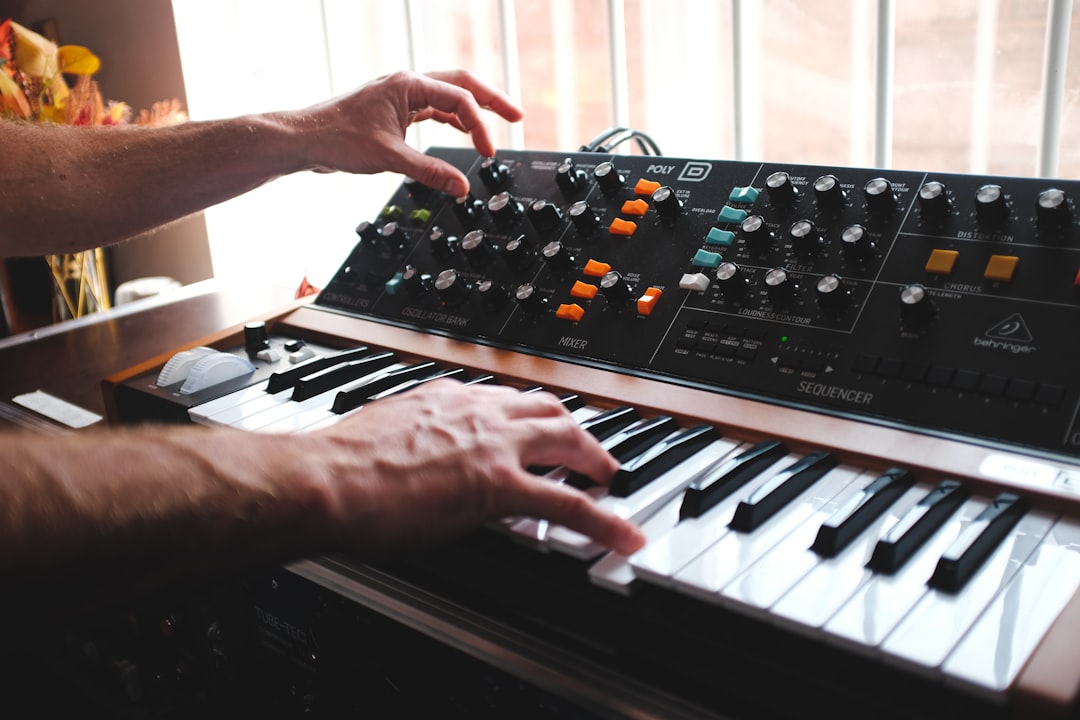
A bass synth is a synthesizer — hardware or software — set up to generate low-frequency notes that form the bassline of a track. So if you are asking what is a bass synth, the short answer is: it is any synth voiced for the bottom octaves, using oscillators, a filter and an envelope to create everything from a smooth sub rumble to a snarling, distorted lead bass. It is the backbone of most electronic, hip-hop and pop productions.
Violet Recording is reader-supported — we may earn a commission from links on this page, at no extra cost to you.
Unlike a recorded electric or upright bass, a bass synth builds its sound from scratch. That gives you total control over the tone, the attack, how much low end you push, and how the note moves over time. Once you understand the handful of controls that shape it, you can dial in almost any bass sound you hear.
What is a bass synth actually doing under the hood?
Every bass synth follows the same basic signal path. One or more oscillators generate the raw waveform — the pitch and harmonic character. That signal passes through a filter, which removes or emphasises frequencies to shape the tone. An amplifier controls the volume over the length of the note, and envelopes and an LFO (low-frequency oscillator) add movement so the sound is not static.
The reason a synth sounds like a bass rather than a lead or a pad comes down to how it is voiced: notes played low on the keyboard, oscillators tuned an octave or two down, a filter that keeps things dark, and — crucially — monophonic playback so only one note sounds at a time. Basslines are almost always mono, because stacking low notes turns clarity into mud fast.
The oscillators: where the tone begins
The oscillator is the sound source, and the waveform you choose sets the harmonic foundation. A few classics show up again and again in bass patches:
- Sine wave — pure, no harmonics. This is the go-to for a sub bass: the deep, felt-more-than-heard energy under a track. On its own it is almost invisible on small speakers, which is why it is often layered.
- Sawtooth — bright and buzzy, full of harmonics. The foundation of most reese, acid and aggressive synth basses. It has plenty of material for a filter to carve into.
- Square/pulse — hollow and woody, with a distinctive nasal quality. Great for punchy, rounded basses; narrowing the pulse width thins it out for a reedier tone.
- Triangle — softer than a saw, with a little more warmth than a pure sine. A useful middle ground for mellow, rounded bass.
Many bass patches use two oscillators. A common trick is to run one sine or triangle for the sub weight and a saw or square an octave up for the audible tone. Detuning a second oscillator slightly against the first thickens the sound, but for tight low end keep detune modest — heavy detune down low smears the pitch.
The filter: shaping and moving the sound
The filter is where most of a bass synth’s character lives. A low-pass filter — the most common choice for bass — lets low frequencies through and rolls off the highs. The cutoff control sets where that roll-off starts, and resonance boosts a narrow band right at the cutoff point, adding a vocal or squelchy emphasis.
What makes a bass sound alive is modulating the cutoff. Route a filter envelope to the cutoff and each note opens up bright then settles darker, giving that classic “pluck” or “wow” attack. Route an LFO to the cutoff and the tone wobbles rhythmically — the basis of the dubstep-style growl. That interaction between a saw oscillator, a resonant low-pass filter and a fast envelope is the recipe behind the famous acid bass sound.
Envelopes and how the note moves over time
Envelopes control how a parameter changes across the life of a note, using four stages known as ADSR: Attack, Decay, Sustain and Release. There are usually at least two — one for the amplifier (volume) and one for the filter.
- Attack — how fast the note reaches full level. For punchy bass keep this near zero so notes start instantly; a slow attack gives a swelling, fade-in bass.
- Decay — how quickly it drops from the peak to the sustain level. Short decays create plucky, staccato basses.
- Sustain — the level held while you hold the key. High sustain gives long, even notes; low sustain makes each note fade toward silence.
- Release — how long the note rings out after you let go. Keep this short on bass so notes do not overlap and muddy the groove.
A tight, punchy bass usually means fast attack, moderate decay, and short release. If your low end feels sloppy, the release time is the first thing to shorten.
How to use a bass synth in a mix without muddying the low end
Getting a bass synth to sit is as important as designing the sound. A few habits keep the bottom end clean:
- Stay mono in the lows. Keep everything below roughly 100–120 Hz centred. Wide, stereo sub energy causes phase problems and disappears on mono systems. Many producers use a utility plugin to mono the low band.
- Carve room with the kick. The kick drum and bass fight for the same space. Either tune them to different frequency pockets or use sidechain compression so the bass ducks each time the kick hits. Our guide to EQ and compression fundamentals covers the technique in detail.
- High-pass everything else. Roll low frequencies off pads, guitars and vocals so the bass owns the bottom. The same mindset applies when you mix vocals and want them clear of the low end.
- Add controlled saturation. A touch of distortion or saturation adds upper harmonics, which help the bass cut through on phones and laptop speakers that cannot reproduce sub frequencies at all. This is why a pure sine sub is almost always layered with a harmonically richer tone.
Gain staging matters here too — if your synth is clipping before it reaches the mix, no amount of EQ will fix it. If that is new to you, start with gain staging explained.
Sub bass, mid bass and lead bass: knowing what you need
“Bass synth” covers a few distinct jobs, and knowing which one a part needs saves a lot of guesswork:
- Sub bass lives below about 80 Hz and provides weight and energy. It is usually a clean sine or triangle with almost no movement — its job is to be felt.
- Mid bass sits roughly 80–300 Hz and carries the audible pitch and groove. This is where most of the character and rhythm live.
- Lead bass pushes higher and brighter, often distorted, and doubles as a hook — think reese basses or aggressive synth-bass riffs.
Plenty of tracks split the bass into two layers: a clean sub for the low weight and a filtered, saturated mid-bass for the tone and movement. Splitting them lets you process each independently, which is far easier than wrestling one patch to do both.
Free bass synths and where to get more
You do not need to spend anything to start. Several excellent free soft synths handle bass well: Vital is a modern wavetable synth with a generous free tier, Surge XT is a fully open-source synth with a huge preset library, and TAL-NoiseMaker is a simple, classic-sounding synth that is superb for punchy analogue-style bass. Any of these will teach you the oscillator-filter-envelope workflow that transfers to every other synth. For a wider look, see our roundup of the best free synth VSTs.
When you are ready to move up to premium instruments — dedicated bass synths, analogue emulations and vast preset packs — you can browse and compare options at a store like Plugin Boutique, which regularly runs sales and free-plugin giveaways worth watching.
Whatever you use, the fundamentals are identical. Learn what the oscillators, filter and envelopes do on one synth and you can sit down at any other and get a usable bass in minutes. For more on building sounds from the ground up, browse the rest of our sound design guides.
Frequently asked questions
Is a bass synth the same as a regular synthesizer?
It is the same instrument, just voiced for low notes. A “bass synth” is usually a synthesizer set to monophonic playback, tuned an octave or two down, with a darker filter and tight envelopes. Most software synths can be a bass synth, a lead or a pad depending on how you set them up — the term describes the role, not a separate category of hardware.
Should a bass synth be mono or stereo?
Keep the low frequencies mono. Below roughly 100–120 Hz, stereo width causes phase cancellation and can vanish on mono playback systems like club rigs and phone speakers. You can add subtle stereo interest in the upper harmonics of a bass, but the fundamental and sub should sit dead centre for a solid, translatable low end.
Why does my bass sound thin on laptop speakers?
Small speakers cannot reproduce sub frequencies, so a pure sine sub simply disappears on them. The fix is to add upper harmonics — layer a brighter oscillator or add saturation/distortion — so the ear infers the missing low pitch from the harmonics it can hear. That is why almost every commercial bass has some grit alongside the clean sub.



