
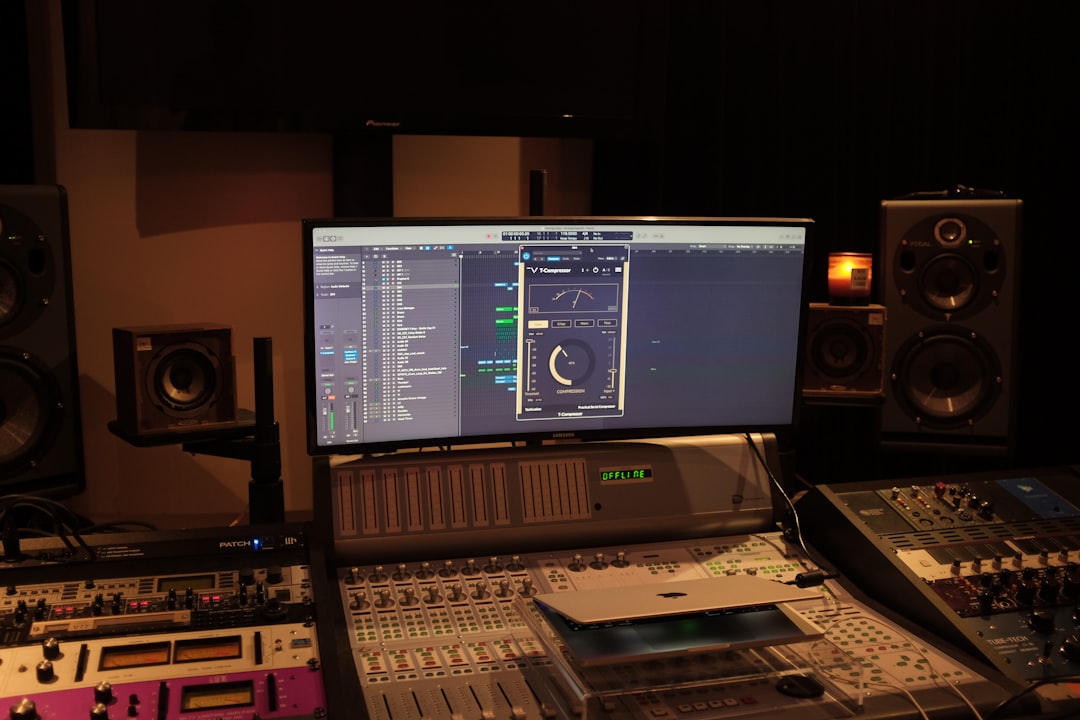
Learning how to mix low end comes down to three things: giving the kick and bass their own space, keeping the sub-bass controlled and mostly mono, and leaving enough headroom so the low frequencies stay tight instead of muddy. Get those right and everything above 200 Hz suddenly sounds clearer too. This guide walks through the moves that matter, with starting points you can trust and adjust by ear.
Violet Recording is reader-supported — we may earn a commission from links on this page, at no extra cost to you.
The low end is the hardest part of a mix to judge, mostly because small speakers, laptops and earbuds barely reproduce it. That is exactly why it needs a deliberate approach rather than guesswork. Below we break the low frequencies into their sub-ranges, sort out the kick-versus-bass relationship, and cover the checks that stop your bass from falling apart on other systems.
What counts as the low end, and why it’s so tricky
Roughly speaking, the low end runs from about 20 Hz up to 250 Hz, and it helps to think of it in three bands. The sub-bass (around 20–60 Hz) is felt more than heard — it’s the rumble and weight. The bass proper (around 60–150 Hz) is where the fundamental notes of a bass guitar or synth and the body of a kick drum live. The low mids (around 150–250 Hz) add warmth but are also where mud and boxiness build up fastest. These figures are approximate starting reference points, not hard boundaries — every instrument and genre sits slightly differently.
The reason low end is tricky is physical. Long bass wavelengths interact heavily with your room, creating peaks and nulls that make a note sound loud in one spot and vanish two feet away. Small monitors and headphones roll off before you even reach the sub. So before you touch a single fader, treat your room where you can, and check the low end on more than one system. If you want a fixed anchor, mix at a consistent, moderate volume so your ears aren’t fooled by the loudness curve of your hearing.
How to mix low end: kick and bass in the same space
The core challenge is that the kick drum and the bass instrument both want the same frequencies, and if they fight, the whole mix loses punch. The goal is to make them fit together like puzzle pieces rather than stack on top of each other. Start by deciding who owns the sub. In most modern pop, hip-hop and electronic music the bass (or an 808) owns the deep sub, and the kick provides the transient click and body above it. In a lot of rock and acoustic music the kick carries more low-end weight and the bass guitar sits just above it.
A reliable technique is complementary EQ. Find the kick’s fundamental — often somewhere around 50–100 Hz — and give it a gentle boost there. Then on the bass, make a small cut in that same region so it steps out of the kick’s way, and let the bass shine a little higher, maybe around 80–120 Hz where its note definition lives. Reverse the logic if the bass owns the sub: carve a small dip in the kick where the bass fundamental sits. These are modest moves — a couple of dB is usually plenty. Your stock EQ handles this perfectly; there’s no need for anything fancy.
When two elements still overlap in time as well as frequency, sidechain compression is the classic fix. Trigger a compressor on the bass from the kick so the bass dips a hair every time the kick hits, opening a pocket for the transient. Start subtle — a few dB of gain reduction with a fast attack and a release timed to the tempo — and only push it harder if the style calls for that obvious pumping effect.
Starting EQ moves for a tight, controlled bottom
Before you carve anything, clean up. Put a high-pass filter on every track that has no useful low-end information — vocals, guitars, cymbals, most synths, reverb returns. Rolling those off somewhere between 80 and 120 Hz (by ear, and higher for thin sources) removes rumble and low-frequency build-up you were never going to hear anyway, and instantly clears space for the instruments that actually belong down there. Be careful not to high-pass so aggressively that you thin out a source’s natural warmth.
On the kick and bass themselves, a few common moves:
- Tame the mud. If the low end sounds boxy or blanketed, a gentle cut around 200–400 Hz on the bass often clears it up.
- Add definition. A kick can gain beater click and audibility on small speakers from a small lift around 2–5 kHz; a bass guitar gets string and pick detail from around 700 Hz–2 kHz. That upper detail is what lets people hear the bass on phones that can’t reproduce the sub at all.
- Control the sub. If the sub is wild and uneven, a very high-pass or shelf below about 30 Hz removes inaudible rumble that only eats headroom.
Compression on the bass evens out note-to-note level so no single note booms while others disappear. A ratio around 3:1–4:1 with a medium attack and enough gain reduction to smooth the performance is a sensible starting point — adjust to taste. For the deeper mechanics of subtractive EQ and gain reduction, our EQ and compression fundamentals guide covers the why behind these moves.
Keep the sub-bass mono and check it in mono
Low frequencies carry a lot of energy, and if your sub is spread wide in stereo it can cause phase problems, weaken the centre, and even skip the needle on a vinyl pressing. The standard practice is to keep everything below roughly 100–120 Hz mono, or very close to it. Many EQs and utility plugins have a “mono below” or bass-mono control that does this in one click; if not, pan your bass and kick dead centre and avoid stereo wideners on them.
Just as important, check your whole mix in mono regularly. Phone speakers, many Bluetooth speakers and club subs sum to mono, and a mix that sounds huge in stereo can lose its bass entirely when summed if there are phase cancellations. If the low end drops out in mono, you have a phase problem to hunt down — often between a kick and bass, or between multiple mics on one source. You can sanity-check levels and phase relationships with the free meters in our audio tools suite.
Referencing, headroom, and leaving room for mastering
Your ears lie about bass, so borrow someone else’s ears: reference a commercial track in a similar style. Import it into your session, level-match it to your mix, and A/B how much low end it really has. Almost everyone overdoes the bass in isolation and is surprised how controlled professional mixes actually are. Reference on your monitors, your headphones, and a phone or laptop speaker — if the kick and bass survive all three, you’re in good shape.
Leave headroom. Aim to have your mix bus peaking a few dB below 0 dBFS — landing your loudest peaks somewhere around −6 dBFS is a common, comfortable target — so nothing clips and the mastering stage has room to work. Low end is where headroom disappears fastest, because sub energy is invisible on small speakers but huge on the meter. Watch a peak meter, not just your ears.
Mastering is where final loudness and tonal balance get set. Most streaming platforms normalise playback toward roughly −14 LUFS integrated (treat that as an approximate, common reference rather than a rule), and a mastering engineer or service will shape the low end to translate everywhere. If you don’t have a dedicated engineer, an online mastering service like can handle it, and you can read our overview of what mastering is and how loud your master should be before you commit. The better your low end is controlled at the mix stage, though, the easier that final step becomes.
Common low-end mistakes to avoid
A few habits sink more mixes than anything else. Boosting instead of cutting — piling on low-end boosts to make things bigger usually just adds mud; carving space with cuts is almost always more effective. Mixing too loud — high volume flatters the bass and tricks you into using less than you need, or the reverse. Ignoring the low mids — that 150–400 Hz region is where fullness and mud both live, so treat it carefully. And trusting one pair of speakers — without cross-checking, you’re guessing. Build the habit of referencing and mono-checking every time, and your low end will start translating from your room to the rest of the world.
For more on the fundamentals feeding into all of this, see our beginner’s guide to mixing your first song, the companion how to mix vocals walkthrough, and browse the full mixing and mastering hub.
Frequently asked questions
Should the kick or the bass be louder in a mix?
There’s no fixed rule — it depends on the genre. In bass-forward styles like hip-hop and EDM the bass or 808 often dominates the sub while the kick provides the click; in rock and acoustic music the kick usually carries more weight. What matters more than which is louder is that they occupy complementary frequencies and don’t mask each other, which you achieve with EQ and sidechain compression.
Why does my bass disappear on some speakers?
Small speakers, phones and laptops physically can’t reproduce sub-bass, so a mix that relies only on deep frequencies vanishes on them. The fix is to give the bass definition higher up — around 700 Hz to 2 kHz — so listeners perceive the note even without the sub. A mono phase problem can also make bass drop out, which is why checking your mix in mono is essential.
What frequency should I high-pass non-bass tracks at?
There’s no single number — do it by ear. A common starting range is 80–120 Hz for vocals and guitars, moving higher for thin sources like overheads or a distant room mic. High-pass until you hear the source start to thin out, then back off slightly. The aim is to remove rumble and low-end clutter without stealing a track’s natural body.



