
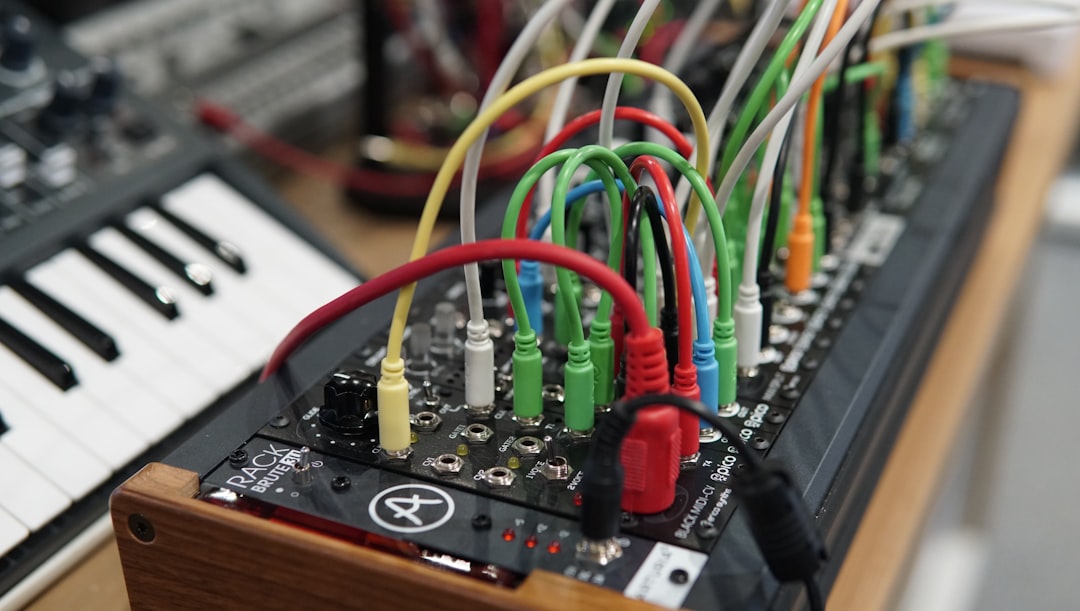
Static sounds get boring fast. Modulation is what gives a patch movement and life, turning a flat tone into something that breathes, evolves and feels expressive. Good modulation sound design is the difference between a synth that sounds like a held note and one that sounds like a performance. Almost any parameter, pitch, filter cutoff, volume, effect amount, can be modulated, and learning where to route that movement is a core skill.
This guide explains the main modulation sources and how to use them creatively. If oscillators and filters are still new, start with designing sounds with a synth, then layer this on top.
What modulation means
Modulation simply means one signal automatically changing a parameter over time. A modulation source (like an LFO) controls a modulation destination (like filter cutoff). The connection between them, often set in a mod matrix, has an amount that decides how strong the effect is. Effective modulation sound design is mostly about choosing the right source, destination and amount.
LFOs: cyclical movement
A low-frequency oscillator repeats a shape over and over to create regular motion. Common uses:
- Vibrato — a slow sine LFO on pitch.
- Tremolo — an LFO on volume.
- Filter wobble — a tempo-synced LFO on cutoff (the heart of a wobble bass).
- Width and shimmer — LFOs on pan or effect parameters.
Sync the LFO to your tempo for rhythmic movement, or leave it free-running for organic drift. If LFO basics are fuzzy, our LFO explainer covers them.
Envelopes: one-shot shaping
Where an LFO repeats, an envelope happens once per note. The amplitude envelope shapes volume, but assigning a second envelope to filter cutoff, pitch or effect depth adds expressive contour: a quick filter envelope creates a snappy pluck, a slow one opens a pad as the note sustains. Modulation envelopes are how you make a sound do something the moment a key is pressed.
The mod matrix and the power of layering modulation
Synths like Serum, Vital, Phase Plant and Arturia Pigments offer a mod matrix where you freely connect sources to destinations. The magic comes from stacking modulators: an LFO on cutoff, plus an envelope on the LFO’s depth, plus velocity on the envelope. Layered modulation creates complex, evolving behaviour that never quite repeats. Combined with layered sounds, this is how huge, living patches are built.
Useful modulation sources beyond LFOs
- Velocity — how hard you play; route it to filter or volume for dynamic expression.
- Key tracking — higher notes brighter, lower notes darker.
- Macros — one knob controlling many parameters at once, great for live performance and quick variation.
- Envelope followers and random/sample-and-hold — for reactive or unpredictable movement.
Modulate effects, not just the synth
Modulation is not limited to the oscillator stage. Automate or modulate reverb size, delay feedback, distortion drive or filter cutoff inside your effects chain to keep textures evolving. Modulating distortion drive over time, for instance, lets a sound grow more aggressive into a drop, the same trick that powers good risers and sweeps. This is essential for textures and atmospheres that need to feel alive across a long section.
How to choose the right modulation for a sound
The hardest part is not making modulation work, it is deciding what a sound actually needs. A useful approach is to start from the feeling you want and work backwards to the source and destination.
- Want gentle realism? Reach for slow, free-running LFOs at tiny depths on pitch and cutoff. Real instruments are never perfectly stable, and a fraction of a semitone of drift is enough to suggest an analogue or acoustic origin.
- Want rhythmic energy? Tempo-sync an LFO to cutoff, pan or volume and pick a rate that locks to the groove, an eighth or sixteenth for fast motion, a bar or two for slow sweeps.
- Want expression under your fingers? Route velocity and an envelope to cutoff so the sound reacts to how you play rather than running on autopilot.
- Want a long evolving texture? Stack several slow modulators at different rates so their peaks rarely line up, which keeps a pad shifting without ever obviously repeating.
Choosing the destination matters as much as the source. Cutoff is the most expressive target because the ear is sensitive to changes in brightness, pitch is powerful but unforgiving, and amplitude or pan modulation tends to sit best when it is subtle. When in doubt, modulate cutoff first and add others only if the sound still feels flat.
A simple way to build movement into a patch
If a sound feels static and you are not sure where to begin, work through it in layers rather than trying to design everything at once:
- Start with a filter envelope on each note so the patch has an attack shape and is not the same from start to finish.
- Add one slow LFO to cutoff at a small depth for ongoing life, synced to tempo if the part is rhythmic.
- Route velocity to the filter envelope amount so harder notes open up and the part responds to your playing.
- Only now reach for the mod matrix to add a second, slower modulator, perhaps on pitch or an effect, to introduce variation across longer passages.
Building up in this order means every modulator earns its place, and you can always hear what each one is contributing before adding the next. Most of this is easier on a capable instrument, so it is worth working in one of the best free synths for sound design while you learn.
Common modulation mistakes to avoid
- Too much depth. Wild pitch or cutoff swings sound like an effect rather than a musical movement. Pull the amount back until the motion supports the sound instead of dominating it.
- Forgetting to sync. An unsynced LFO on a rhythmic part drifts in and out of time and muddies the groove. Sync anything meant to feel rhythmic.
- Modulating everything at once. When every parameter is moving, nothing reads as intentional. A few well-aimed modulators always beat a tangle of them.
- Ignoring bipolar versus unipolar. If a parameter only ever climbs from its set value, the resting tone can feel wrong. Use bipolar modulation where you want movement above and below the centre.
- Leaving the destination at full range. Modulation amount and the parameter’s own setting interact, so set the base value first, then dial the modulation depth around it.
Keep modulation musical
- Subtlety reads as realism — small amounts of pitch and filter drift make sounds feel analogue.
- Sync to tempo for anything rhythmic so movement locks to the groove.
- Don’t modulate everything — a few well-chosen movements beat chaos.
- Use bipolar modulation where you want a parameter to move both above and below its set value.
Frequently asked questions
What is the difference between an LFO and an envelope?
An LFO repeats a shape continuously to create ongoing, cyclical movement. An envelope happens once each time a note is triggered, shaping how a parameter changes from attack to release. Use LFOs for repetition and envelopes for per-note contour.
How do I make a static patch sound more alive?
Add small amounts of modulation to pitch and filter cutoff, sync an LFO to tempo for subtle movement, and let an envelope open the filter on each note. Stacking a few gentle modulators creates an evolving, organic feel.
What is a mod matrix?
A mod matrix is a routing grid in a synth that lets you connect any modulation source to any destination with an adjustable amount. It is the central hub for building complex, layered modulation behaviour.
Should I modulate pitch or filter cutoff first?
Filter cutoff is usually the safer place to start because the ear hears changes in brightness as movement without the sound feeling out of tune. Pitch modulation is more exposed, so keep its depth small unless you are deliberately after a dramatic effect.
Why does my modulation sound robotic?
Robotic results usually come from a single fast LFO at high depth doing all the work. Lower the amount, slow it down, and combine it with a second modulator at a different rate so the motion is less obviously repetitive and more like natural drift.



