
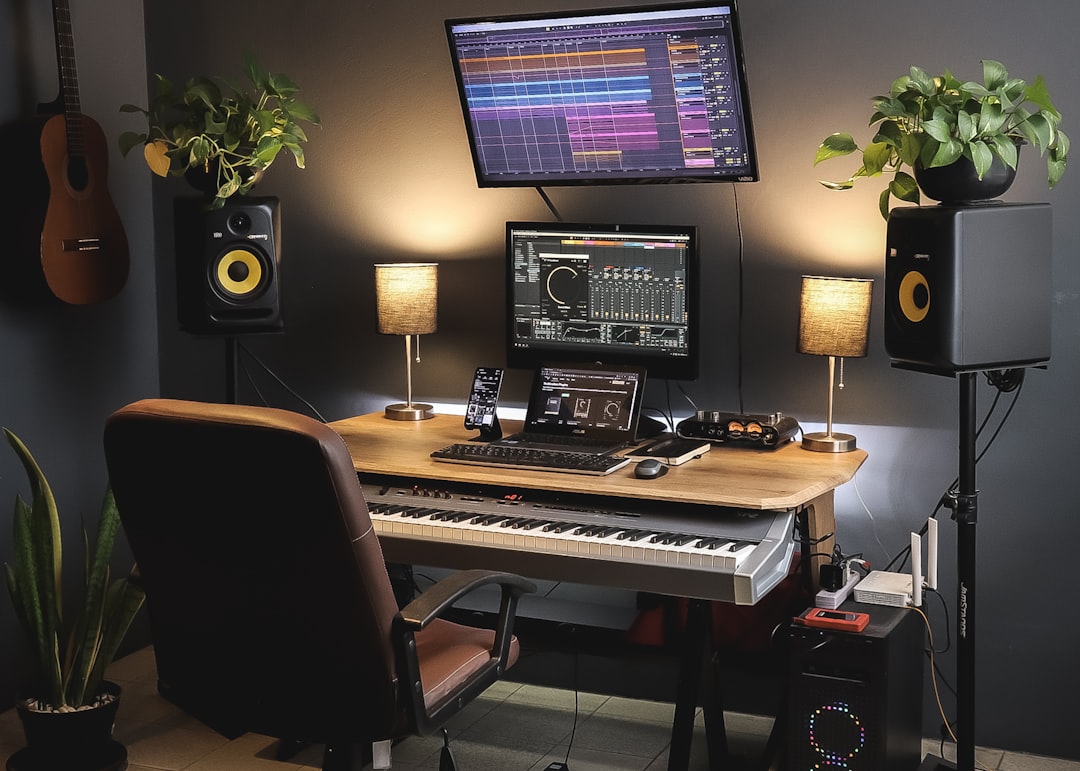
To make a beat for a rapper, start with a simple 4-bar loop at 80–95 BPM, program a hard-hitting drum pattern, tune an 808 to the key of your melody, and then arrange it into sections that leave open space for vocals. The whole point is restraint: a rapper needs room to breathe, so the beat should hit hard but never crowd the pocket where the bars live.
This guide walks you through the full process — tempo, drums, 808s, swing, melody and arrangement — the way a working producer would explain it to someone starting out.
Violet Recording is reader-supported — we may earn a commission from links on this page, at no extra cost to you.
What you’ll need before you start
You don’t need a big studio. A laptop, a DAW, and a pair of headphones will get you a professional-sounding instrumental. Here’s the short list:
- A DAW — FL Studio, Ableton Live, or a free option. FL Studio’s step sequencer is a favourite for hip-hop, but GarageBand or any free DAW for beginners works fine while you learn.
- Drum sounds — kicks, snares/claps, hi-hats, and percussion. A stock kit is enough to start; you can upgrade later.
- An 808 or sub bass — this is the backbone of most modern rap beats.
- A melody source — a piano, a synth, a guitar loop, or a sample.
- Headphones or monitors you can trust for the low end.
Steps at a glance
- Set the tempo and pick a key.
- Program the drums — kick, snare, hats, percussion.
- Write the 808 bassline and tune it to your key.
- Add a melody or sample as the hook of the instrumental.
- Add swing and small variations so it grooves.
- Arrange it into intro, verse, and hook sections.
- Rough-mix so the vocal will sit on top.
Step 1: Set the tempo and pick a key for the rapper
Tempo is the first decision because it shapes the entire feel. Most rap sits between 70 and 100 BPM, but the trick is that modern trap hats are often written in double-time — so a beat that feels like 140 BPM is usually programmed at 70 BPM with fast hi-hats. Starting slower gives you finer control over hat rolls and 808 glides.
As a rough guide: laid-back, boom-bap and lyrical styles live around 80–90 BPM; energetic trap and drill sit around 130–150 (or 65–75 halved). If you’re unsure what tempo a reference track is running at, drop it into our free BPM finder and metronome tools and match it.
For key, minor keys (A minor, F minor, G minor) dominate rap because they sound darker and more serious. You don’t need theory — pick a minor scale, and keep every melodic element and your 808 inside it. Locking everything to one key is the single biggest thing that separates a beat that sounds “produced” from one that sounds like clashing samples.
Step 2: Program drums that hit hard and stay out of the way
Drums are where a rap beat lives or dies. Build them one layer at a time so each element has a clear job.
Kick and snare — the skeleton
Lay your kick and snare/clap first, because they define the pocket. The classic backbone puts the snare (or clap) on beats 2 and 4, and the kick on beat 1 plus a syncopated hit or two. Don’t over-program it — a rapper counts off the snare, so keep it consistent and let the kick move around underneath. Two or three well-placed kicks per bar beat a busy pattern every time.
Hi-hats — the energy and the motion
Hi-hats carry the momentum. Start with steady eighth or sixteenth notes, then introduce rolls — short bursts of 32nd or triplet notes — to add lift before a snare or at the end of a phrase. Vary the velocity (how hard each hat hits) so the pattern breathes instead of sounding like a machine gun. One or two rolls per 4 bars is plenty; over-rolling makes a beat exhausting to rap over.
Percussion — the flavour
A single open hat, a rim shot, or a shaker in the right spot adds character without clutter. Add these last, and mute them if they fight the vocal pocket. Restraint is the whole skill here.
Step 3: Build the 808 bassline
The 808 is the tuned kick-bass that defines modern rap low end. Treat it as an instrument, not a drum: it has notes, and those notes must be in your key. Write a simple 808 pattern that follows the root notes of your melody — often the 808 and kick hit together on the main downbeats so the low end punches as one.
Two techniques make 808s sound professional:
- Glide / portamento — sliding from one 808 note to the next creates that liquid, sliding bass that’s everywhere in trap. In most DAWs you enable this by overlapping two notes with the instrument set to mono/legato.
- Note length control — a long 808 sustains and fills space; a short one leaves a gap. Shorten your 808s where the rapper’s flow gets busy, and let them ring where the beat opens up.
Because the 808 and kick share the same low frequencies, they can cancel each other out and lose punch. Sidechain the 808 to duck slightly whenever the kick hits, or shorten one of them, so both stay audible. This is the most common beginner mistake — a “quiet” beat is usually a kick and 808 fighting for the same space.
Step 4: Add the melody or sample that defines the beat
Now give the beat its identity. This can be a piano line, a dark synth, a guitar loop, a bell, or a chopped sample. Keep it simple — a two- or four-bar melodic loop is usually all a rapper needs, because a busy, ever-changing melody competes with the lyrics for attention.
If writing melodies from scratch feels intimidating, loops are a legitimate and fast starting point. Producers routinely pull royalty-cleared melody loops, one-shots and drum sounds from a service like Splice, then chop and rearrange them into something original. Browsing a curated loop library is also a great way to learn what makes a melody sit well under vocals.
Whether you play it in or start from a loop, the rule is the same: leave space. Try muting the melody entirely during the verse sections and bringing it back for the hook — space in the arrangement is what gives the rapper room to command attention. For inspiration on tools, our roundup of the best beat-making apps and the best free drum VSTs can point you to sounds worth trying.
Step 5: Add swing so the beat grooves instead of marching
A grid-perfect beat can feel stiff and robotic. Swing (also called groove or shuffle) nudges certain notes slightly off the grid so the beat has a human bounce. Most DAWs have a swing percentage — start around 8–15% on your hi-hats and see how it loosens the feel.
You can also humanise manually: pull a few hats a hair early or late, and vary velocities so no two hits are identical. The goal isn’t sloppiness — it’s the subtle push-and-pull that makes a head nod. Rappers ride that groove, so a beat with the right swing is far easier to write to.
Step 6: Arrange the full beat for a rapper’s song structure
A loop is not a song. To make a beat a rapper can actually record to, you need to arrange your 4- or 8-bar loop into full sections. A typical rap structure looks like this:
- Intro (4–8 bars) — often just melody or drums, easing in. Great spot for a DJ tag or a spoken intro.
- Verse (16 bars) — strip elements back. Mute the busiest melodic parts and let the drums and 808 drive so the bars are front and centre.
- Hook / chorus (8 bars) — bring everything in. Add the full melody, extra percussion, maybe an octave-up counter-melody so the hook lifts.
- Second verse, second hook, outro — repeat with small variations, then wind down.
The arranging principle for rap is contrast through subtraction. Instead of constantly adding new sounds, you create energy by taking elements away in the verse and dropping them back in at the hook. That dynamic shift tells the listener where the energy is — and it hands the rapper an obvious pocket in the verse.
Add transitions between sections: a reverse cymbal, a filter sweep, a drum fill, or an 808 that drops out for a bar before the hook. These little moments are what make a beat feel finished rather than looped.
Step 7: Rough-mix so the vocal will sit on top
You’re making a bed for a voice, so don’t mix the beat to sound huge on its own — mix it to leave room. Pull the beat’s overall level back so a vocal can sit clearly above it (many producers keep the instrumental peaking a few dB below where they would for a standalone track). Carve a little space in the 1–4 kHz range where vocal presence lives, and keep the low end tight so the 808 and kick don’t muddy the voice.
If you’re new to balancing levels, our guides to gain staging and EQ and compression fundamentals cover the basics that apply directly to beat mixing. When it’s time to polish, the mastering overview explains how to get the final loudness right.
Turn your beat idea into a full track
Sometimes you’ve got a hook or a concept but no rapper on hand to test it — or you just want to hear the idea as a finished song. If that’s where you’re at, you can turn a beat idea into a complete, original track with AI at Solmi, then use what you learn about song structure to sharpen the instrumental you’re building here.
Common mistakes when you make a beat for a rapper
- Overcrowding the mix — too many melodic layers leave no room for the voice. When in doubt, mute something.
- Kick and 808 clashing — sidechain or tune them together so the low end punches.
- No dynamics — a beat that never changes across sections is boring to rap over. Subtract for verses, add for hooks.
- Melody in the wrong key as the 808 — everything must share one key, or it sounds off.
- Too much hat rolling — energy is good, exhausting is not. Use rolls as punctuation.
Make a few beats following this process and it becomes second nature. If you want to start earning from your instrumentals once they’re solid, see our guide on how to start selling beats, and browse more tutorials in Mobile Music Production.
Frequently asked questions
What BPM should a beat for a rapper be?
Most rap sits between 70 and 100 BPM, though trap and drill are often written at 130–150 (which is the same feel as 65–75 with double-time hats). Slower, lyrical styles favour 80–90 BPM. Match a reference track with a BPM tool if you’re unsure, then adjust to taste.
Do I need expensive software to make a beat?
No. A free DAW, stock drum sounds, and a single 808 are enough to make a release-quality beat. Paid tools and larger sample libraries speed things up and expand your palette, but they don’t make the beat — arrangement and restraint do. Learn the craft on free tools first.
How do I leave enough space for the rapper’s vocals?
Space comes from arrangement, not just mixing. Strip melodic layers back during verses so the drums and 808 carry it, keep the melody simple, and mix the instrumental a few dB below where you’d master a standalone track. The goal is a clear pocket in the midrange for the voice to occupy.



