
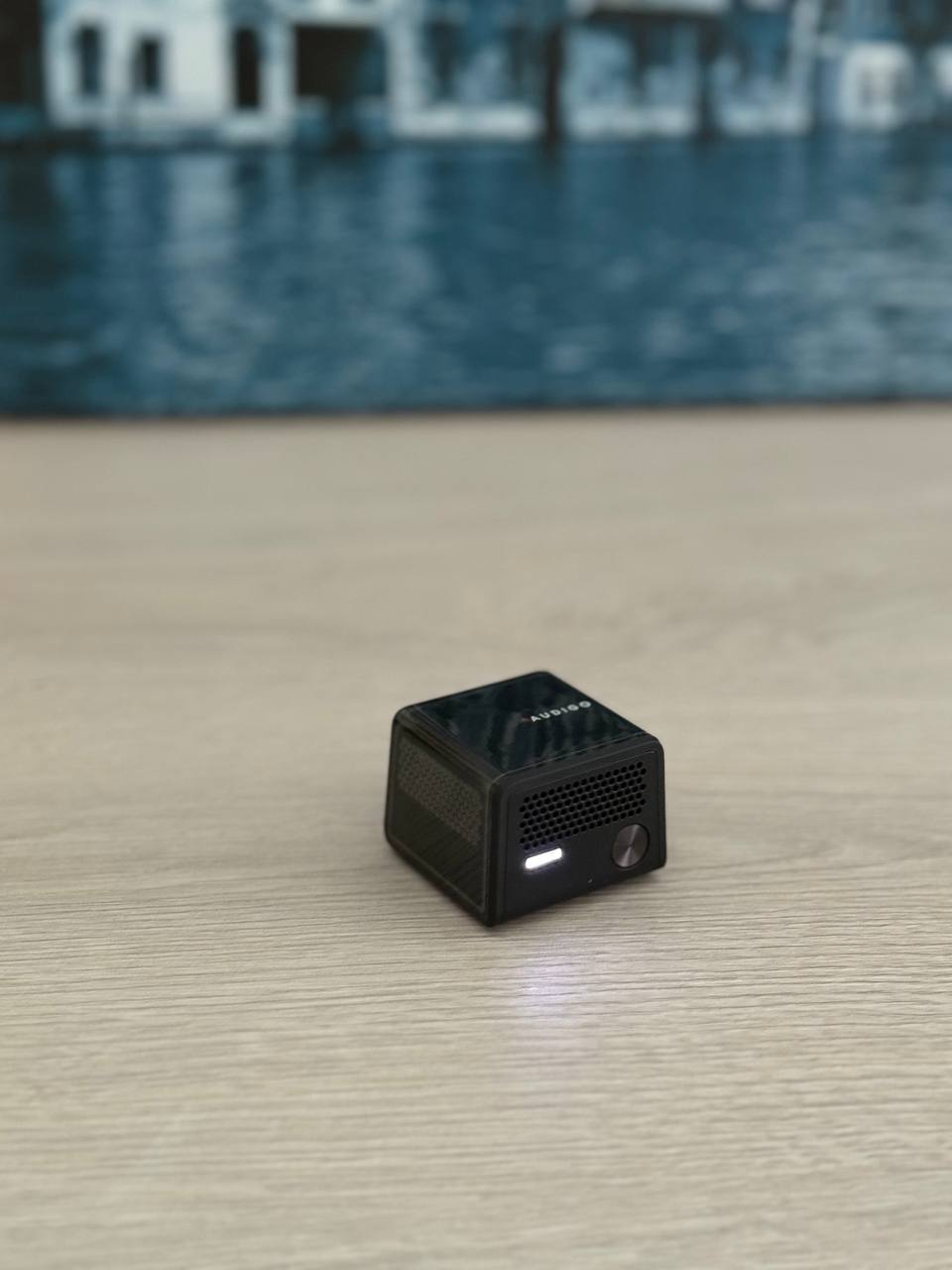
The Audigo vs a field recorder comparison is the one that gets closest to what Audigo really is. Reviewers keep describing it as “a mini field recorder” — and a traditional handheld recorder like a Zoom H-series or Tascam DR is the established way to capture great audio anywhere. Both give you high-quality portable recording without a computer, but they take opposite approaches: the recorder is a self-contained box with a screen and controls, while Audigo is a wireless mic that lives through your phone.
Violet Recording is reader-supported — we may earn a commission from links on this page, at no extra cost to you.
Below we break down what each really does, who it suits, and where each falls short.
Audigo vs a field recorder at a glance
The short version: choose a field recorder if you want physical controls, live headphone monitoring, XLR inputs and total independence from a phone. Choose Audigo if you want the smallest possible wireless capture that flows straight into a phone-based multitrack and video workflow.
- Form: a field recorder is an all-in-one handheld with a screen, buttons and an SD card; Audigo is a tiny wireless mic plus a phone app.
- Monitoring: recorders have a headphone jack for live monitoring; Audigo does not monitor live.
- Inputs: higher-end recorders (e.g. Zoom H5/H6) accept XLR/TRS external mics; Audigo is its own mic only.
- Workflow: recorders write to an SD card you offload later; Audigo transfers to your phone and edits in-app, with video sync.
- Price: entry recorders can be cheaper; Audigo sits around $249 with its app ecosystem included.
What Audigo does well
The Audigo records a full-quality 24-bit/48kHz WAV file to its own internal memory, then transfers it to your phone — and it does so wirelessly, on battery, in a body barely bigger than a matchbox. You can place it near the source across the room, hit record, and never worry about a cable.
Its two capsules work in a mid-side arrangement for a real stereo image with a sense of space, and you can adjust the stereo width afterward in the Audigo Studio app. From there you can build a multitrack project, sync up to four Audigos, and even export a video with the audio automatically lined up — all from your phone, with no interface or laptop.
It is not flawless. Because it records to internal memory, you cannot monitor the signal live while recording, its noise reduction is gentle, and some advanced app features sit behind the paid Studio+ subscription. Our full Audigo review has the complete rundown.
What a field recorder does well
A handheld field recorder is a proven, self-reliant tool. It has built-in stereo mics, a screen, physical gain and transport controls, a limiter, and — crucially — a headphone jack so you can monitor exactly what you are capturing in real time. It records to an SD card, runs on AA or internal batteries, and needs no phone, app or pairing to work. Newer models add 32-bit float recording, which makes clipping almost impossible.
Step up to a recorder with XLR/TRS inputs and it doubles as a portable interface for professional microphones — ideal for interviews, field recording, ambience, foley, live gigs and podcasts where you want tactile control and total independence from a phone. If reliability through physical controls and live monitoring matter most, a recorder is hard to beat.
Audigo vs a field recorder: which should you choose?
Pick a field recorder if you value physical controls, live headphone monitoring, XLR inputs for external mics and a workflow that never touches a phone — the safer, more flexible choice for serious field and interview work. Pick the Audigo if you want the smallest, most convenient way to capture music in stereo and drop it straight into a phone-based multitrack and video app, wirelessly and standalone. The recorder is the tactile, do-everything box; Audigo is the pocket-sized, app-first take on the same idea.
Read our full hands-on Audigo review for the details, or see how it compares with dedicated mics: Audigo vs Shure MV88, Audigo vs Røde Wireless GO II and Audigo vs DJI Mic 2. Still weighing models? Compare the best Audigo alternatives.



