
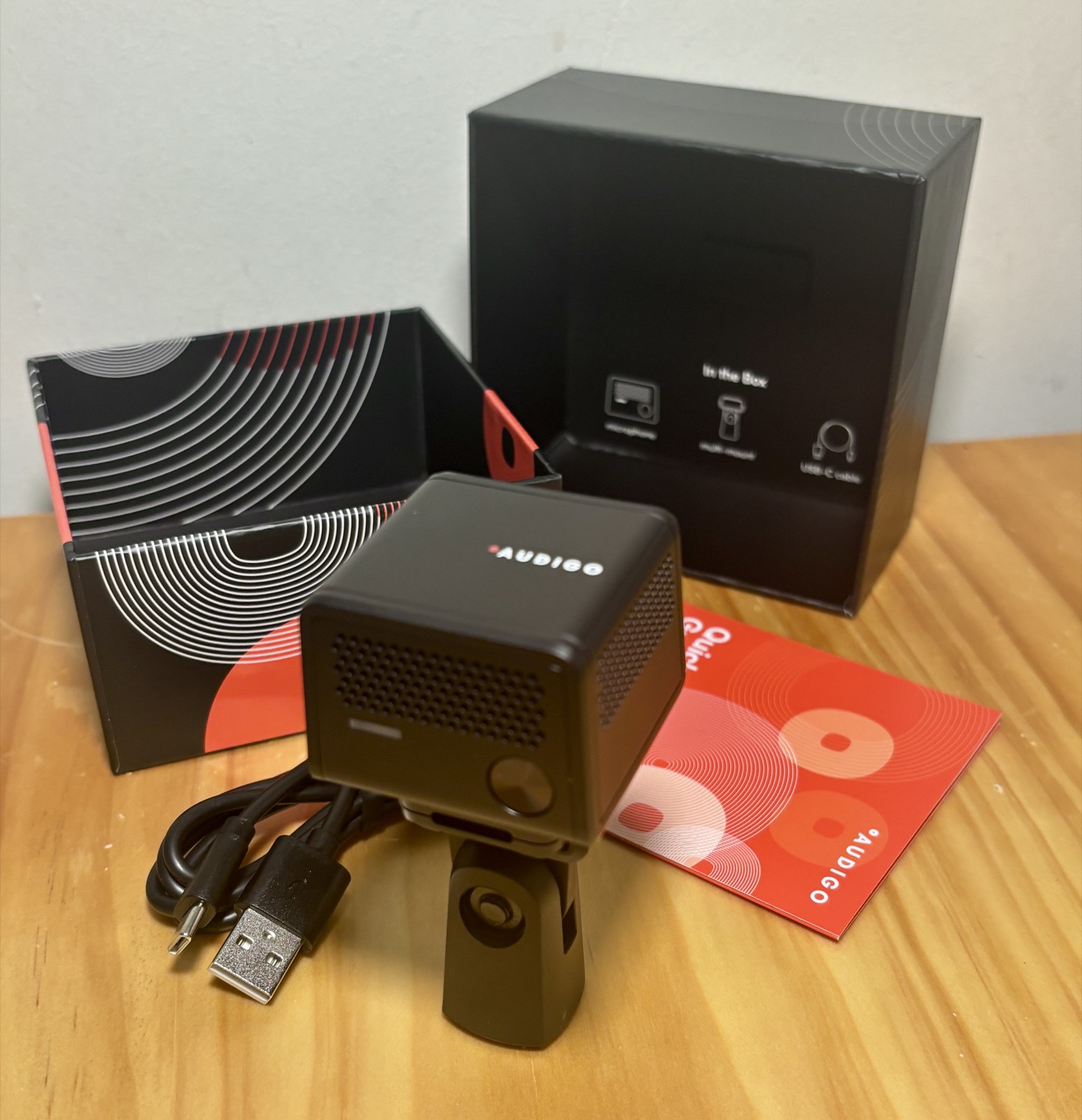
The Audigo is a brilliant little mic for capturing music in stereo — but it is not for everyone. Maybe you want live monitoring, XLR inputs, cleaner dialogue for video, or simply a lower price. Whatever the reason, these are the best Audigo alternatives, grouped by what you are actually trying to record, so you can find the right fit fast.
Violet Recording is reader-supported — we may earn a commission from links on this page, at no extra cost to you.
Why look for an Audigo alternative?
Audigo is really two things: a tiny wireless mic and a freemium recording app. It records a 24-bit/48kHz WAV to its own memory, then edits in Audigo Studio — which is free to start, with a paid Studio+ tier for cloud storage, collaboration and advanced tools. The trade-offs: you cannot monitor the signal live, the mic itself runs around $249, and it is US-focused. The upside is you can install the free app and try the workflow before spending anything. If it is still not the right fit, one of the options below may suit you better. (For the full picture, see our hands-on Audigo review.)
The best Audigo alternatives
Shure MV88+ — best budget phone mic
A compact digital stereo condenser that plugs straight into your phone and records in real time, so you can monitor as you go. It is cheaper than the Audigo and dead simple for talking-head video, quick interviews and voice notes — the trade-off is that it stays tethered to the phone rather than being placed across the room. See our full breakdown in Audigo vs Shure MV88, or check the MV88+ on Amazon.
Røde Wireless GO II — best for dialogue and video
If your real need is clean speech — interviews, vlogs, two-person podcasts — a dual-channel wireless lav system beats a stereo room mic. The Wireless GO II clips onto your subjects, records onboard as backup and drops into a camera workflow. More in Audigo vs Røde Wireless GO II, or check the Wireless GO II on Amazon.
DJI Mic 2 — best premium wireless for creators
The most polished wireless lav kit for video: 32-bit float recording on the transmitters, a touchscreen receiver, a charging case and smart noise cancelling. Ideal for vlogging and dialogue where you want a forgiving, grab-and-go system. Compare them in Audigo vs DJI Mic 2, or check the DJI Mic 2 on Amazon.
Zoom H6 — best for XLR inputs and live monitoring
A handheld field recorder gives you what Audigo deliberately leaves out: physical controls, a headphone jack for live monitoring, and XLR/TRS inputs so you can plug in professional mics. The Zoom H6 is the do-everything choice for interviews, field recording and podcasts. See Audigo vs a field recorder, or check the Zoom H6 on Amazon.
Tascam DR-40X — best budget field recorder
A well-loved, affordable handheld with built-in adjustable stereo mics and XLR/TRS inputs — a lot of recorder for the money if you want tactile control and independence from a phone without spending flagship prices. Check the Tascam DR-40X on Amazon.
Zoom H1essential — cheapest 32-bit float capture
The budget pick. It is tiny, records in 32-bit float (so clipping is almost impossible), has a headphone jack for monitoring and costs a fraction of the Audigo. It lacks XLR inputs and wireless placement, but for grab-and-go stereo capture on a tight budget it is superb value. Check the Zoom H1essential on Amazon.
Which Audigo alternative should you pick?
- Cheapest phone upgrade: Shure MV88+ (or the Zoom H1essential for a standalone recorder).
- Dialogue and video: Røde Wireless GO II, or the DJI Mic 2 for a premium ecosystem.
- XLR inputs + live monitoring: Zoom H6, or the Tascam DR-40X on a budget.
- Music capture, wireless and pocketable: stick with the Audigo — it is still the most convenient for placing a stereo mic near a performance.
Is the Audigo still the one to beat?
For its core job — capturing instruments, vocals and rooms in stereo, wirelessly, straight into a phone-based multitrack and video app — the Audigo remains uniquely convenient. The alternatives win on price, live monitoring, XLR inputs or dialogue, but they are all just hardware. Audigo is an ecosystem: the free Audigo Studio app handles multitrack, EQ and video sync, and Studio+ adds cloud storage, collaboration and advanced tools as you grow — a recurring, evolving toolkit rather than a one-off box. Best of all, you can try that whole workflow free before you commit.
Read the full Audigo review for our verdict, or dig into the head-to-heads: vs Shure MV88, vs Røde Wireless GO II, vs DJI Mic 2 and vs a field recorder.



