
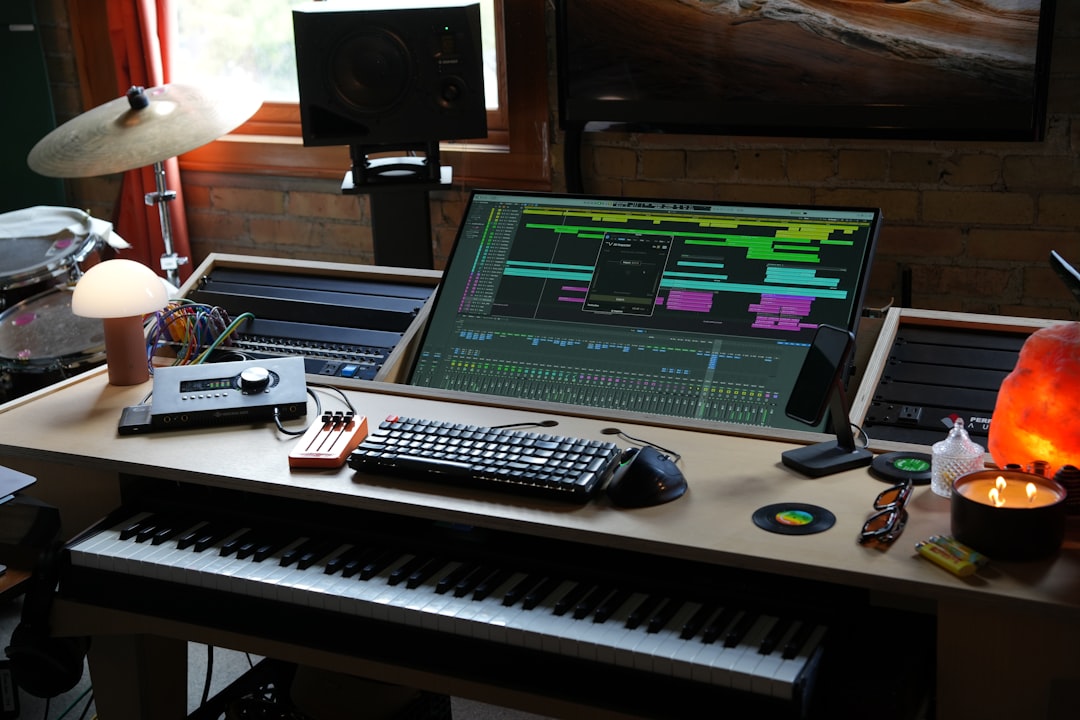
To make a hi-hat pattern that actually grooves, start with steady eighth or sixteenth notes on a grid, then bring it to life with velocity changes, occasional open hats, swing, and a few fast rolls. The hats are the pulse that ties your kick and snare together, so small human touches matter more than complexity. Get the timing and dynamics right and even a simple loop will feel alive.
Violet Recording is reader-supported — we may earn a commission from links on this page, at no extra cost to you.
What you’ll need before you build a hi-hat pattern
You don’t need much. A DAW with a step sequencer or piano roll (FL Studio, Ableton, GarageBand — any of them will do), a decent closed and open hi-hat sample, and a kick and snare already laid down so you have something to lock the hats against. If you’re on a phone, the same ideas apply in a mobile beat maker. Set your tempo first — most hip-hop and trap sits between 130 and 160 BPM (often felt at half that), and house or pop tends to sit around 120–128. If you’re unsure of the tempo of a reference track, run it through Violet Recording’s free production tools to find the BPM before you start programming.
Steps at a glance
- Lay down a steady base of closed hats (eighths or sixteenths).
- Vary velocity so the hats breathe instead of machine-gunning.
- Add open hi-hats for lift, usually on the offbeat.
- Apply swing or micro-timing to loosen the grid.
- Drop in rolls and triplets for movement (especially in trap).
- Arrange variation across the song so it never gets boring.
Start with a steady base on the grid
Every good hat pattern begins boringly on purpose. Open your sequencer and place a closed hi-hat on every eighth note — that’s two hats per beat, eight across a bar in 4/4. Play it back against your kick and snare. That steady chak-chak-chak is your foundation, and honestly, for a lot of boom-bap and lo-fi beats you barely need more than this.
Want more energy and detail? Switch to sixteenth notes — four hats per beat, sixteen per bar. This is the backbone of trap, drill, and most modern hip-hop. It sounds busy on its own, but the trick isn’t the number of notes; it’s what you do with them next. A wall of identical sixteenth notes sounds like a fax machine. The steps below are how you turn that grid into a groove.
Use velocity so the pattern breathes
Velocity — how hard each hit is played — is the single biggest thing separating a lifeless pattern from one with feel. A real drummer never hits every hat with identical force. Their hand naturally accents some notes and ghosts others.
Recreate that. In your piano roll or step sequencer, pull down the velocity on most hats and push up a few accents. A classic move is to accent the “and” of each beat, or to accent every fourth hit in a sixteenth-note run so the ear hears a pulse inside the stream. Let the quieter ghost notes sit low in the mix. Even a small amount of random velocity variation — many DAWs have a humanize or randomize function for exactly this — instantly makes the pattern sound played rather than drawn. If your hats still feel stiff, that’s almost always a velocity problem, not a note-placement problem.
Add open hi-hats for lift and space
Closed hats are the pulse; open hats are the punctuation. An open hi-hat rings out longer and gives the pattern air. The most common placement is on the offbeat — the “and” between beats — which is where disco, house, and a ton of pop live. In hip-hop and trap, a single open hat right before the next bar acts like a little breath that pulls you into the loop again.
One thing to watch: when a closed hat lands immediately after an open hat, the closed hit should “choke” the open one, cutting its ring short — just like a real hi-hat pedal closing. Many drum samplers handle this automatically with a choke or mute group; if yours doesn’t, shorten the open hat’s decay so it doesn’t wash over the next note. That open-then-closed choke is one of those tiny details that reads as “professional” without anyone knowing why.
Loosen the grid with swing and micro-timing
Perfectly quantized hats sit dead on the grid, and dead-on-the-grid can feel robotic. Swing pushes every other note slightly late, creating that shuffling, laid-back bounce you hear in everything from J Dilla beats to UK garage. Almost every DAW has a global swing or groove control — start around 8–16% and listen. A little goes a long way; too much and it starts to feel drunk.
Beyond swing, try nudging individual hats a few milliseconds early or late by hand. Pulling the backbeat hats a touch behind the beat gives a relaxed, behind-the-pocket feel; pushing them slightly ahead adds urgency. This micro-timing is exactly what “human feel” means, and it’s a big part of why programmed drums from experienced producers sound better than someone else’s stock loop. If you want to hear the difference between a stiff and a swung pattern, tap the tempo out on a metronome tool first so your ear has a straight reference to compare against.
Program rolls, triplets and trap-style hats
Rolls are where a hi-hat pattern gets its personality, especially in trap. A roll is just a burst of faster subdivisions — thirty-second notes, triplets, or even sixty-fourths — usually leading into a new bar, a snare, or a drop. Program a short run of tightly spaced hats and pull their velocities into a rise or fall so the roll swells or fades instead of blasting at one flat volume.
Triplet hats — three evenly spaced hits in the space of two — are the signature trap flavour. Mix straight sixteenths with the odd triplet run and you get that stuttering, rhythmic tension modern beats live on. Pitch is a tool too: sliding the pitch of a roll up or down as it plays (a quick automation clip or a pitch envelope on the sampler) gives that recognisable “zipping” hat sound. The rule that keeps rolls musical is restraint — a roll every bar gets exhausting fast. Use them to mark transitions, not to fill every gap.
Choose hi-hat sounds that fit the beat
The pattern is only half the job; the sound of the hat matters just as much. A crisp, bright closed hat cuts through a busy trap beat, while a softer, darker hat suits lo-fi and soul. You can layer two hats — one for the transient click, one for the body — to build a fuller sound, then EQ out any harshness around 6–10 kHz if it gets fatiguing.
If you want quality one-shots and ready-made hat loops to pull from, a subscription sample service like Splice gives you a deep, genre-sorted library you can audition and drag straight into your project. Building from a pro-recorded hat and then programming your own pattern around it is often faster than sculpting a hat from scratch. If you’d rather stick with what you have, most free drum plugins ship with usable hats too — our roundup of the best free drum VSTs is a good place to grab a starter kit, and the best beat-making apps guide covers mobile options.
Arrange the pattern across the whole track
A hat pattern that loops identically for three minutes will bore the listener, no matter how good the groove is. Treat the hats as a storytelling element. Keep them sparse in the intro and first verse, add sixteenths and the first rolls when the beat opens up, strip them almost to silence in a breakdown, then bring them back busier for the final chorus. Even just muting the hats for the last two beats before a drop creates tension that makes the drop hit harder.
Small variations sell the arrangement: change the roll placement every eight bars, drop an extra open hat into the turnaround, or mute a random hat here and there so no two bars are perfectly identical. This is the difference between a loop and a track. If you’re building beats to sell, that kind of dynamic arrangement is also what makes a beat feel finished and license-ready — see our guide on how to start selling beats for what buyers listen for.
Turn your hi-hat pattern into a finished song
Once your hats are grooving, they’re a great seed for a full arrangement. If you’ve got a rhythmic idea but want to hear it fleshed out into a complete track with melody, chords, and structure, you can feed the concept into an AI music tool like Solmi and use what it generates as a springboard for your own production — a fast way to test whether a groove has a song in it before you commit hours to it.
Frequently asked questions
How many notes should a hi-hat pattern have?
There’s no fixed number. Eighth notes (eight per bar) suit boom-bap and lo-fi; sixteenth notes (sixteen per bar) suit trap and modern hip-hop. What matters is velocity and variation, not raw density — a simple pattern with good dynamics beats a busy one that hits every note at the same volume.
Why does my hi-hat pattern sound robotic?
Almost always because every hit has identical velocity and sits perfectly on the grid. Vary the velocity so some hats accent and others ghost, add a touch of swing, and nudge a few hats slightly off the grid. Those small imperfections are what your ear reads as “human.”
What’s the best tempo for programming hi-hats?
It depends on the genre — around 120–128 BPM for house and pop, 130–160 BPM for trap and hip-hop (often felt at half-time). The hat subdivision matters more than the raw tempo: faster subdivisions like sixteenths and triplets read as more energetic at any BPM. Find a reference track’s tempo with a BPM tool first, then match it.
For more on programming and mixing your drums, browse the Sound Design hub, and if you’re just setting up, start with the best free DAWs for beginners.



