
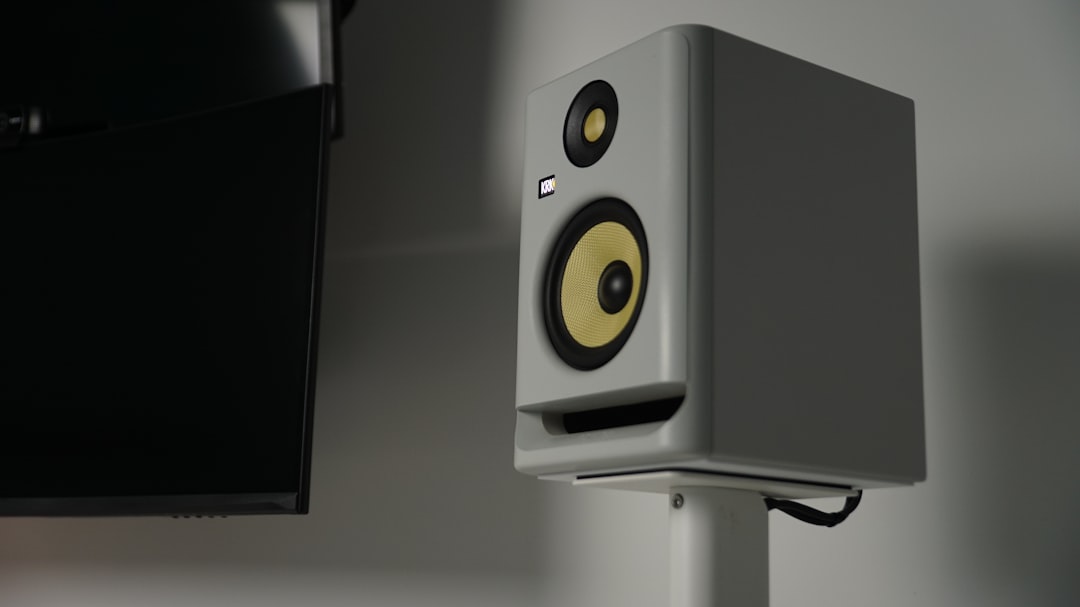
If you’re stuck on hs5 vs hs7, here’s the short answer: choose the HS5 for small rooms and desks where the 5-inch woofer stays tight and honest, and step up to the HS7 only if your room is treated and you genuinely need the extra low-end reach from its 6.5-inch driver. Both are the same accurate, slightly clinical Yamaha voicing — the real decision is about size, bass, and how much space you’re working in.
Violet Recording is reader-supported — we may earn a commission from links on this page, at no extra cost to you.
The quick verdict on the HS5 vs HS7 for most home studios
For the majority of bedroom and spare-room setups, the Yamaha HS5 is the smarter buy. It’s easier to place, less likely to overload an untreated room with bass, and it forces you to make mix decisions on a flat, revealing response rather than an impressive-sounding one. The Yamaha HS7 earns its place when your room is a bit bigger, at least lightly treated, and you’re regularly working with bass-heavy material — hip-hop, electronic, cinematic — where hearing down toward the low 40s Hz actually changes your decisions.
| Spec | Yamaha HS5 | Yamaha HS7 |
|---|---|---|
| Woofer | 5″ cone | 6.5″ cone |
| Tweeter | 1″ dome | 1″ dome |
| Amp power (LF/HF) | 45W + 25W (70W total) | 60W + 35W (95W total) |
| Frequency response | 54 Hz – 30 kHz | 43 Hz – 30 kHz |
| Best room size | Small (desk / small bedroom) | Small-to-medium, ideally treated |
| Cabinet size / weight | Smaller, lighter | Noticeably bigger, heavier |
| Best for | Tight nearfield mixing, limited space | Bass-forward genres, more headroom |
| Price tier | Lower | Higher |
| Where to buy | Shop on Amazon | Shop on Amazon |
Prices move around, so we don’t quote figures here — Check the current price on Amazon for the HS5, and Check the current price on Amazon for the HS7 before you decide.
What the two monitors actually have in common
Before the differences, it helps to know how much these two share, because it narrows what you’re really choosing between. Both the HS5 and HS7 belong to the same HS-series line, the modern descendant of the legendary Yamaha NS-10 that sat on top of countless mixing consoles. Both use a 1-inch dome tweeter, a bi-amplified design with separate amplifiers for the woofer and tweeter, and the same white-coned, black-cabinet look that has become a studio cliché for good reason.
They also share Yamaha’s tuning philosophy: a deliberately flat, uncoloured response that doesn’t flatter your mix. Cheap consumer speakers hype the bass and the sparkle so music sounds exciting. The HS series does the opposite — it tells you the truth, even when the truth is that your low end is muddy and your vocal is too bright. That’s the point of a reference monitor. Mixes you get sounding good on an HS5 or HS7 tend to translate well to phones, cars, earbuds and laptops.
Both models also have the same rear-panel room controls: a ROOM CONTROL switch that tames low-end buildup when you place them near a wall, and a HIGH TRIM switch to roll off or lift the treble. Both offer balanced XLR and TRS inputs, so they slot straight into any interface. In other words, connectivity and philosophy are identical — the fork in the road is size and low-frequency reach.
Where the HS7’s bigger woofer changes the game
The headline difference is the woofer: 5 inches on the HS5, 6.5 inches on the HS7. That extra cone area, paired with a larger cabinet and more amplifier power, is why the HS7 reaches down to a rated 43 Hz versus the HS5’s 54 Hz. Eleven hertz doesn’t sound like much on paper, but that region covers the fundamental of a lot of bass notes and kick drums. On the HS7 you’ll hear more of the sub weight in a track; on the HS5 that region rolls off, so you’re partly mixing bass “blind” and relying on experience or a subwoofer.
The HS7 also plays louder cleanly and holds composure with dense, full-range material thanks to its 95 watts of total power against the HS5’s 70. If you mix loud, work on bass music, or sit a little further back from your monitors, that headroom matters. The HS7 simply moves more air with less strain.
There’s a catch, though, and it’s the reason we don’t just tell everyone to buy the bigger pair. More bass in an untreated room is often a liability, not a bonus. Small rooms have strong bass resonances (room modes) that make certain low notes boom and others disappear. The HS7 excites those modes harder than the HS5 does. In a small, bare bedroom, an HS7 can sound impressively big while actively misleading you about your low end — you turn the bass down to compensate for a room hump, and the track ends up thin everywhere else. The HS5’s gentler bass is, ironically, easier to trust in a bad room.
How your room and desk should decide it
This is where most buying advice goes wrong: it compares the speakers in isolation and ignores the space they’ll live in. Nearfield monitors like these are meant to be heard up close — roughly an equal-sided triangle where the distance between the two monitors matches the distance to your head, with the tweeters at ear height. Get that right and both models perform well. Get it wrong and neither will.
Use the HS5 if any of these describe you: you mix on a desk in a small or untreated room; your listening position is within about 1.2 metres; you’re primarily doing vocals, singer-songwriter, acoustic, podcast or pop where deep sub content is limited; or you simply don’t have space for larger cabinets. Its tighter, more controlled bass is a feature in these conditions, not a compromise.
Step up to the HS7 if: your room is medium-sized and has at least some acoustic treatment (bass traps in the corners especially); you sit a bit further back; or your genre lives and dies on low end. If you go this route, plan for treatment — the HS7 rewards a good room and punishes a bad one. Our guides on how to position studio monitors and acoustic treatment for home studios will get more out of whichever pair you pick than upgrading the speakers ever would.
The subwoofer question, and who should skip the debate entirely
Here’s a route a lot of people miss. If you love the tight, honest nearfield presentation of the HS5 but worry about missing bass, the cleanest solution is often an HS5 plus a Yamaha HS8S subwoofer added later, rather than jumping to the HS7. The sub handles the lowest octave, you cross it over above the HS5’s roll-off, and you keep the smaller mains that are easier to place. That combination usually beats a pair of HS7s in a small room, because you can position the sub independently to fight room modes.
That said, a sub in an untreated room is its own can of worms and needs careful setup, so it’s an upgrade path, not a day-one requirement. For a lot of beginners, a single well-placed pair of HS5s plus decent headphones for bass checks is the pragmatic answer. If you’re torn between spending on monitors versus headphones at all, read studio monitors vs headphones for mixing before you commit — plenty of home mixers get further with a good pair of reference headphones and a treated pair of ears than with bigger speakers in a bad room.
- Yamaha HS5 — the versatile small-room default. Shop on Amazon
- Yamaha HS7 — more bass and headroom for treated rooms and bass-heavy genres. Shop on Amazon
- Yamaha HS8S subwoofer — the smarter way to extend an HS5 rig. Shop on Amazon
Worth cross-shopping before you buy either Yamaha
The HS series isn’t the only game in town, and its dry, analytical voicing isn’t for everyone. Two alternatives are worth a listen if you can. The Adam Audio T5V and larger T7V use a ribbon-style tweeter that many find more detailed and less fatiguing up top than the Yamaha dome, and they’re priced competitively against the HS5 and HS7 respectively. The KRK Rokit 5 G4 is a popular rival too, though its slightly hyped low end makes it more of a “fun” monitor than a strictly neutral reference — useful to know depending on whether you want truth or enjoyment.
None of these is objectively “better” than the Yamahas; they’re different flavours of accurate. If you value a bright, revealing, no-nonsense reference that has decades of studio pedigree behind it, the HS line is a safe, proven choice. If you want a softer top end, audition the Adams.
- Adam Audio T5V — HS5 rival with a ribbon-style tweeter. Shop on Amazon
- Adam Audio T7V — HS7 rival, bigger woofer, smooth highs. Shop on Amazon
- KRK Rokit 5 G4 — popular, slightly bass-forward alternative. Shop on Amazon
Setting up whichever pair you choose
Whatever you land on, the monitors are only half the equation. Position them at ear height, form that equal triangle, keep them off the wall a little (and use the rear ROOM CONTROL switch if you can’t), and treat your first reflection points and corners. If your interface is on the older side or you’re just getting started, our walkthrough on positioning studio monitors and the broader studio monitors hub cover the practical steps. Also learn your speakers by referencing commercial tracks you know inside out — that’s how you calibrate your ears to the HS voicing. And if you’re building a room from scratch, nearfield vs midfield monitors explains why nearfields like these suit home spaces best.
Frequently asked questions
Is the HS7 just a bigger HS5?
Essentially yes, tonally. They share the tweeter, the tuning philosophy, the rear controls and the connectivity. The HS7 has a larger 6.5-inch woofer, a bigger cabinet, more amplifier power and deeper bass extension (down to about 43 Hz versus 54 Hz). If you like the HS sound, the choice comes down to how much bass and volume your room can handle, not tonal preference.
Do I need a subwoofer with the HS5?
Not necessarily. For vocals, pop, acoustic, podcasting and most singer-songwriter work, the HS5’s bass reach is enough, especially if you check low end on headphones. If you mix a lot of bass-heavy electronic or hip-hop, a Yamaha HS8S sub added later is often a better move than switching to HS7s, because you can position the sub independently to tame room modes.
Which is better for a small untreated bedroom?
The HS5. Its tighter, more controlled low end excites room resonances less than the HS7, so it’s easier to trust in a bare room. The HS7’s extra bass tends to expose (and get tripped up by) untreated small-room acoustics. Spend the difference on a couple of bass traps and you’ll hear a bigger improvement than the larger speaker would give you.



