
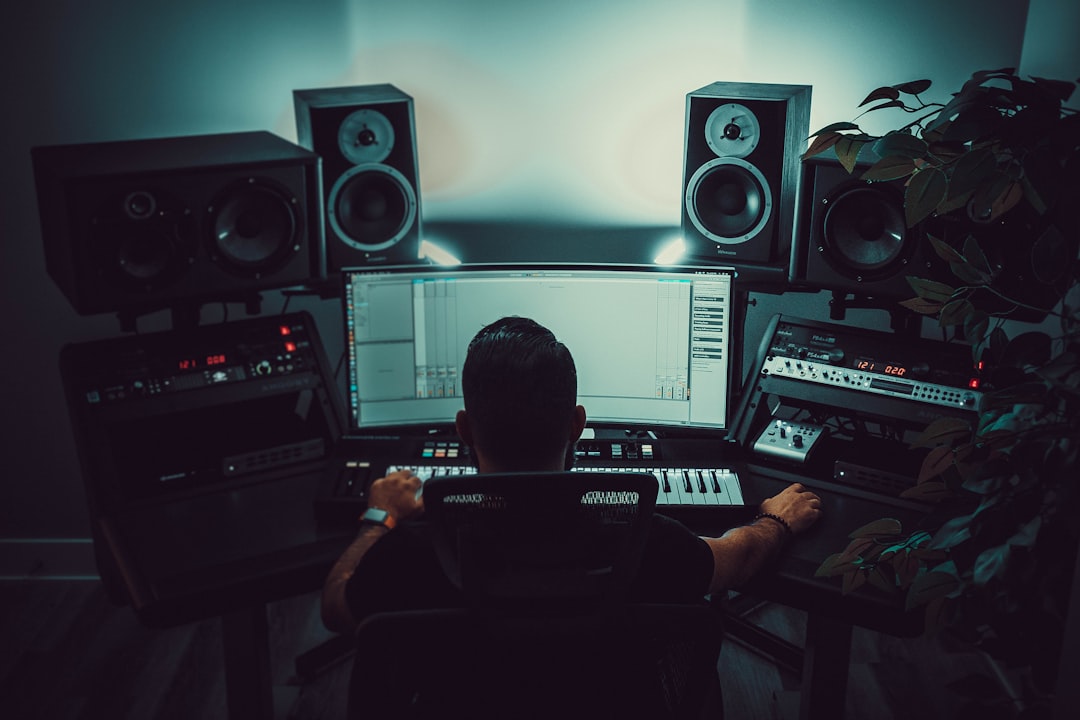
The best studio monitors for beginners are honest, affordable nearfield speakers that show you what your mix really sounds like — not ones that flatter it. For most first-time home studios that means a 4-to-5-inch active pair like the Yamaha HS5, KRK Rokit 5 G4, JBL 305P MkII, Kali Audio LP-6, or the pocket-friendly PreSonus Eris E3.5. Below we compare each pick, explain the buying criteria that actually matter, and help you match a monitor to your room and budget.
Violet Recording is reader-supported — we may earn a commission from links on this page, at no extra cost to you.
Quick-pick comparison table
| Monitor | Woofer | Best for | Why it stands out | Price |
|---|---|---|---|---|
| Yamaha HS5 | 5″ | Reference-flat mixing | Ruthlessly neutral; the classic “if it sounds good here, it sounds good everywhere” pick | Shop on Amazon |
| KRK Rokit 5 G4 | 5″ | Beats, bass, EDM | Front-firing port, DSP room EQ, and a fun low end many producers love | Shop on Amazon |
| JBL 305P MkII | 5″ | Best all-round value | Wide, detailed image thanks to the Image Control Waveguide; punches above its price | Shop on Amazon |
| Kali Audio LP-6 | 6.5″ | Bigger sound on a budget | Extra low-end extension and loud, clean output for the money | Shop on Amazon |
| PreSonus Eris E3.5 | 3.5″ | Tiny rooms & tight budgets | Genuinely good sound in a compact, cheap desktop package | Shop on Amazon |
| Adam Audio T5V | 5″ | Detailed highs | Ribbon-style tweeter gives an airy top end unusual at this price | Shop on Amazon |
What to look for in studio monitors for beginners
Before you compare brands, it helps to know why studio monitors differ from ordinary speakers. A hi-fi speaker or Bluetooth speaker is voiced to make everything sound pleasant — it boosts the bass and treble so your music is fun to listen to. A studio monitor tries to do the opposite: reproduce the audio as flatly and accurately as possible so you can hear problems and fix them. If your mix sounds balanced on a flat monitor, it will translate well to phones, laptops, car stereos and earbuds. That translation is the entire point.
If your goal is enjoying records at home rather than mixing, a speaker voiced for listening is often the better buy. Our roundup of the best speakers for record players covers powered and passive options for that job.
If you mostly want speakers for listening rather than mixing, a flat monitor may not be what you need. In that case, look at our guide to the best budget bookshelf speakers.
Here are the criteria that actually matter when you’re buying your first pair:
- Active, not passive. Every monitor below is “active” (also called “powered”), meaning the amplifier is built into each speaker. You plug your interface straight in — no separate amp to buy or match. This is what you want as a beginner.
- Woofer size vs. room size. The woofer (the big driver) largely determines how much low end you get. A 5-inch woofer suits most home studios and bedrooms. A 6.5-inch pushes deeper bass but needs more space and room treatment to behave. A 3.5-inch is right for a cramped desk or a very small room where a big speaker would just excite bass problems.
- Frequency response. Look for a spec that reaches reasonably low (roughly 45–50 Hz for a 5-inch) without wild peaks. You don’t need a “hyped” response; you need an even one.
- Inputs. Balanced XLR or TRS inputs are ideal because they reject noise over longer cable runs. Some budget models add unbalanced RCA so you can also plug in a turntable, phone or console — handy but not essential for mixing.
- Room-tuning controls. Many monitors have small switches or DSP settings on the back to tame bass when the speaker sits near a wall or in a corner. On a budget, these controls save you from an expensive acoustic problem.
- Buy them in pairs. Some brands sell monitors singly, others as a pair. You need two for stereo. Always check whether the price is for one speaker or two before you hit buy.
One more thing worth saying up front: no monitor fixes a bad room. If you’re spending on speakers, budget a little for basic acoustic treatment too. A cheaper monitor in a treated corner beats an expensive one bouncing off bare walls.
The best beginner studio monitors, compared
Yamaha HS5 — the neutral reference standard
The white-cone Yamaha HS series is probably the most recognisable studio monitor in home studios worldwide, and the 5-inch HS5 is the sensible starting point. It’s famous for being flat to the point of unforgiving: it doesn’t hide harshness, muddy low-mids or a lopsided balance. That can be a shock at first — your favourite records might sound less exciting on it — but that honesty is exactly why so many people mix on them. There’s a bit less deep bass than the 6.5-inch models, so if you make bass-heavy music you may want to add a subwoofer later or check low end on headphones. Room-control switches on the back help you settle it into your space. Shop on Amazon — Check the current price on Amazon.
KRK Rokit 5 G4 — fun low end with built-in room EQ
KRK’s Rokit line, with its trademark yellow cones, has a reputation for a bigger, more exciting low end than the Yamahas. The G4 revision reins in some of the older models’ hype and, crucially, adds onboard DSP with 25 room-correction presets and a graphic EQ, so you can tune the speaker to your desk without extra gear. Many beat-makers, hip-hop and electronic producers gravitate to these because bass feels satisfying while you work. The trade-off is that the low end is slightly flattered, so double-check your bass on headphones or a second source until you learn the speaker. The front-firing port also means you can place them a little closer to a wall than rear-ported designs. Shop on Amazon — Check the current price on Amazon.
JBL 305P MkII — the best all-round value
If you asked a room full of engineers for the best budget monitor, a lot of them would name the JBL 305P MkII. It uses JBL’s Image Control Waveguide — the moulded shape around the tweeter — to throw a wide, precise stereo image with a generous listening “sweet spot”, which is unusual at this price. The overall balance is clean and fairly neutral, sitting between the clinical Yamaha and the fun KRK. For a first pair that does a bit of everything well, this is the safe recommendation. Inputs are balanced XLR and TRS, and there are trim switches for bass and treble. Shop on Amazon — Check the current price on Amazon.
Kali Audio LP-6 — the most speaker for the money
Kali Audio built its reputation by delivering surprising performance at low prices, and the LP-6 (a 6.5-inch design) is the poster child. You get deeper low-end extension and more clean loudness than the 5-inch options, which makes it tempting if your music leans on bass or you just want a bigger sound. The catch is the same as with any 6.5-inch monitor: that extra bass needs a room that can handle it, and the LP-6 really wants some breathing space and a bit of treatment to shine. Kali includes a set of “boundary EQ” dip switches specifically to compensate for placement near walls, on a desk or in a corner — use them. Sold individually, so buy two. Shop on Amazon — Check the current price on Amazon.
PreSonus Eris E3.5 — the small-room, small-budget champion
Not everyone has room (or money) for 5-inch monitors, and that’s where the PreSonus Eris E3.5 comes in. These compact 3.5-inch desktop monitors cost a fraction of the others and still sound genuinely useful — clear mids and controlled highs that beat any computer speaker or soundbar. In a tiny bedroom or on a crowded desk, a smaller speaker can actually be the smarter choice because it excites fewer bass problems than an oversized one crammed against a wall. Don’t expect deep sub-bass, and check low frequencies elsewhere, but as a first step into real monitoring on a shoestring they’re hard to beat. They come as a pair with a handy front-panel volume knob and headphone output. Shop on Amazon — Check the current price on Amazon.
Adam Audio T5V — airy highs on a budget
Adam Audio is best known for pricier studio monitors with distinctive ribbon-style tweeters, and the T5V brings a slice of that character down to a beginner budget. That U-ART tweeter gives an open, detailed, airy top end that’s easy to hear fine reverb tails and sibilance on — helpful when you’re learning to mix vocals and cymbals. The 5-inch woofer keeps things honest in the low end. If you find some cheap monitors sound a bit dull or closed-in up top, the T5V is the antidote. Balanced XLR and unbalanced RCA inputs cover most setups. Shop on Amazon — Check the current price on Amazon.
How to choose the right pair for your room and music
With six solid options, the decision usually comes down to three questions. First, how big is your room? If you’re in a small bedroom or working right up against a wall, lean toward the 5-inch models with room-tuning switches, or the 3.5-inch Eris if space is really tight — a 6.5-inch LP-6 in a cupboard-sized room will fight you on bass. Second, what do you make? Bass-forward genres benefit from the KRK’s fun low end or the Kali’s extension, while acoustic, folk, podcast and mix-for-translation work rewards the flat Yamaha or balanced JBL. Third, what’s your budget for the pair, not the single speaker? Remember some are sold individually.
Whatever you pick, get the setup right: place the two monitors and your head at the points of an equal-sided triangle, tweeters at ear height, pulled away from the wall where you can, and symmetrical in the room. We cover this in detail in how to position studio monitors. It’s also worth understanding nearfield vs midfield monitors — everything on this list is a nearfield, meant to be listened to up close, which is exactly what a home studio needs.
And if you’re still deciding whether to spend on monitors at all versus a good pair of headphones, read studio monitors vs headphones for mixing. The honest answer for most beginners is you’ll eventually want both, because reference headphones let you check the low end and mix quietly at night, while monitors give you the room and stereo picture. For the wider picture on kitting out your space, our home studio gear checklist puts monitors in context with the interface, mic and treatment you’ll want alongside them.
Do you need a subwoofer or room treatment?
Not to start. A 5-inch pair covers enough low end for most beginners to make good decisions, and adding a sub before you’ve treated the room usually creates more problems than it solves — an untreated room already exaggerates or cancels bass unpredictably. Spend first on a couple of thick absorption panels at your early reflection points and, if you can, some bass trapping in the corners. That does more for the accuracy of any monitor than upgrading the speaker itself. Once your room is behaving and you’re consistently making music with heavy sub content, a matched subwoofer becomes worth considering. Until then, keep it simple: good nearfields, sensible placement, a treated room, and headphones for a second opinion.
Frequently asked questions
Are 5-inch monitors big enough for a bedroom studio?
Yes — for most bedroom and home studios a 5-inch active monitor is the sweet spot. It gives enough low end to mix confidently without overwhelming a small room the way a 6.5-inch or 8-inch can. If your space is genuinely tiny or your speakers must sit close to a wall, a 3.5-inch pair like the PreSonus Eris E3.5 can actually give you a cleaner, more honest result.
Do I need an audio interface to use studio monitors?
In almost all cases, yes. Active monitors take a line-level signal, and an audio interface gives you proper balanced outputs plus better sound quality than a computer’s headphone jack. A budget interface like the ones in our guides pairs perfectly with any monitor here — see how to set up an audio interface for the connections. A few small monitors accept a 3.5 mm or RCA input directly, but an interface is still the recommended path.
Which is the best beginner studio monitor overall?
If we had to name one, the JBL 305P MkII is the easiest all-round recommendation: neutral, wide-imaging and excellent value. Choose the Yamaha HS5 if you want the flattest possible reference, the KRK Rokit 5 G4 if you make bass-driven music and want onboard room EQ, the Kali LP-6 for the most low end per dollar, and the PreSonus Eris E3.5 if budget or space is tight. There’s no wrong answer among them — they’re all real, proven picks.
Ready to compare more gear? Browse the full studio monitors category for setup guides and reviews to go with your new pair.



